

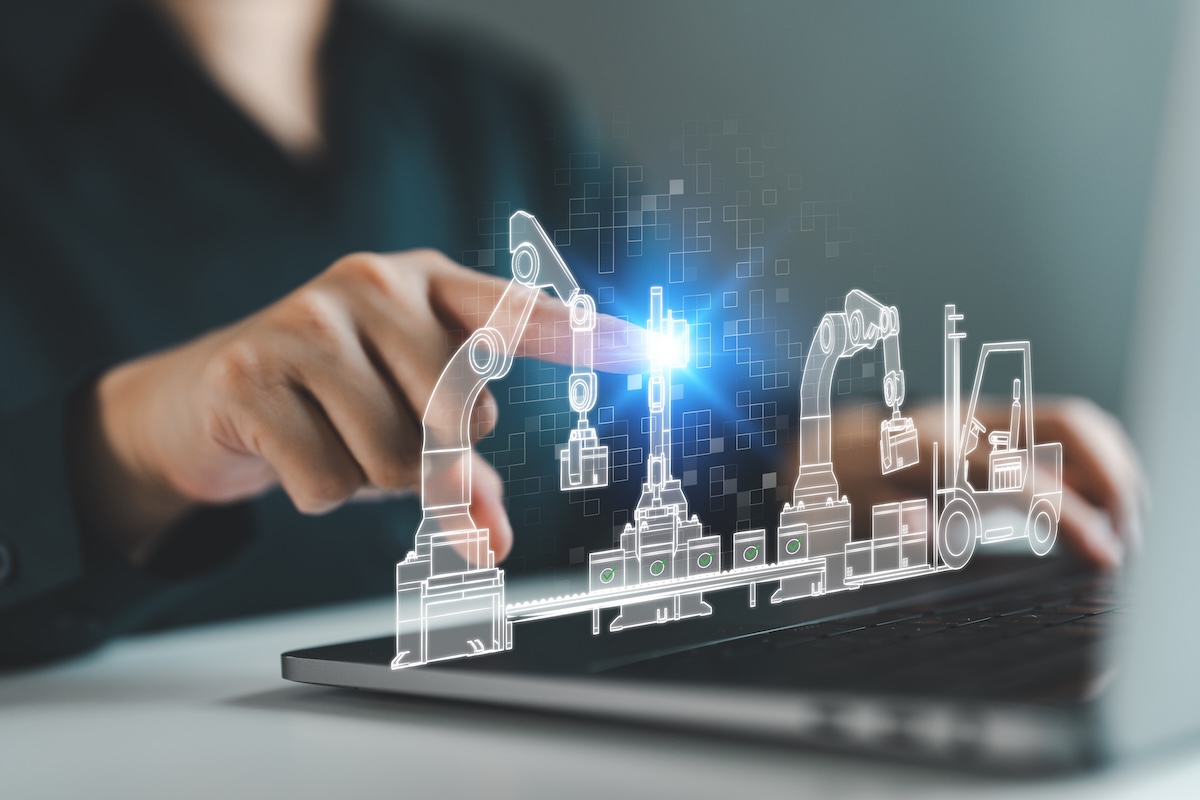
While most manufacturers use Digital Twins to track the health of a single machine or the specs of a complex part, John Biagioni sees a bigger picture. On a recent episode of the Stay Sharp in Digital Engineering podcast, Lampin Corporation’s president argued that the true power of digital twinning isn’t found on the factory floor—it’s found in the boardroom.
According to Biagioni, a business-level digital twin allows leaders to move beyond gut feelings and into a space of high-fidelity simulation and resilience.
Mapping the “What-If” Scenarios
For Biagioni, the foundation of a business digital twin is the Business Continuity Plan. While many companies treat these plans as static documents for emergencies, a digital model transforms them into active tools for growth.
By modeling the business, leadership can simulate “Bull,” “Bear,” and “Base” cases. This allows a company to understand its financial leverage—specifically, how much an incremental dollar of revenue will impact the bottom line, or how the business should deleverage during a market contraction. The goal is to establish a predictable model where, for example, 60% of new revenue flows directly to net income.
Debunking the Myth of Seasonality
One of the more provocative points Biagioni raised during the discussion is that “seasonality does not exist.” From his perspective, what many managers dismiss as seasonal fluctuations are actually environmental conditions that have not been properly measured or accounted for.
He shared an example from Lampin Corporation, where the shop utilizes low-cost IoT sensors to track temperature, humidity, and barometric pressure. When the shop saw a sudden 30% drop in yield during a thermally sensitive process, the data revealed the culprit: a garage door opening for deliveries in 20-degree weather. By integrating environmental data into the business’s digital twin, the team solved a “mystery” that others might have simply dismissed as a seasonal trend.
Carbon vs. Carbide: Resource Decision-Making
A business digital twin also provides a framework for resource allocation, specifically regarding what Biagioni calls “Carbon vs. Carbide.” When a model predicts a 400% surge in demand, a leader must decide how to scale. Hiring and training new staff (Carbon) takes significant time and carries a high lead-time risk in a tight labor market. Alternatively, investing in high-horsepower machine tools (Carbide) might offer a faster, more predictable path to increasing Takt rate. A digital twin allows executives to compare the time-phase constraints and financial impacts of both options before a single dollar is spent.
Building Stakeholder Trust Through Resilience
Ultimately, Biagioni views the business digital twin as a tool for building transparency and trust across three key groups:
- Employees: Providing clarity on job security and growth plans during market shifts.
- The Board: Demonstrating a data-backed understanding of financial performance.
- Customers: Offering reliable commitments on delivery and volume, even in the face of supply chain disruptions.
In a post-pandemic economy, the focus has shifted from mere efficiency to resilience. As Biagioni concluded, modeling the entire business provides a level of stability that allows a company to thrive when others are merely trying to survive.
This post is based on Episode #128 of the Stay Sharp in Digital Engineering podcast.